
Why Kids Stop Asking Questions and How to Bring Their Curiosity Back
If you have a three or four year old at home, you have probably survived countless rounds of “Why?” It happens all day, every day. But something strange happens as kids grow older. The constant stream of curiosity slows down. The questions fade. The child who used to ask about everything now stays quiet. You ask if they have questions, they shake their head. You ask if they understand, they say they’re fine.
Many parents assume this means their child has become “less motivated.” But that is not the case. Cognitive science shows that kids are born with a strong drive to explore. It is the environment and certain psychological factors that make this drive harder to express.
Let’s break down why kids stop asking questions, and what we can do to help them bring their curiosity back.
Why Kids Don’t Ask Questions: Not Laziness, but Roadblocks
Kids don’t ask questions for no reason. Behind every question is a system in the brain called the information requesting mechanism. When kids see something confusing or inconsistent, their brain nudges them to seek answers. That nudge becomes a question.
So why do they ask less as they grow?
You may notice some of these signs:
1. They are afraid of asking the “wrong” thing
Our education system often treats mistakes like flaws. Over time, kids start to think asking a question means exposing what they don’t know. They would rather stay silent than risk embarrassment.
2. The environment doesn’t feel safe
If a child is often corrected, laughed at, or dismissed, the brain switches into defense mode. A defensive brain does not explore. It only tries to protect itself.
3. They don’t know what they don’t know
This happens when their metacognitive skills are still developing. It’s not that they don’t want to ask. They simply can’t sense the gap in their understanding. If the brain doesn’t send the “something’s missing” signal, the question never forms.
So when kids stop asking questions, it does not mean they lack curiosity. It means they need adults to help remove the blocks in their way.
Where Does Curiosity Come From? The Brain Has an Exploration Switch
Interestingly, the brain has a built in system for exploration. When kids encounter something new or surprising, their brain releases dopamine, which feels rewarding. This is like flipping on their “exploration switch.”
This is also why young children ask the most questions: their curiosity system is at full power.
Kids in different age groups ask questions in different ways:
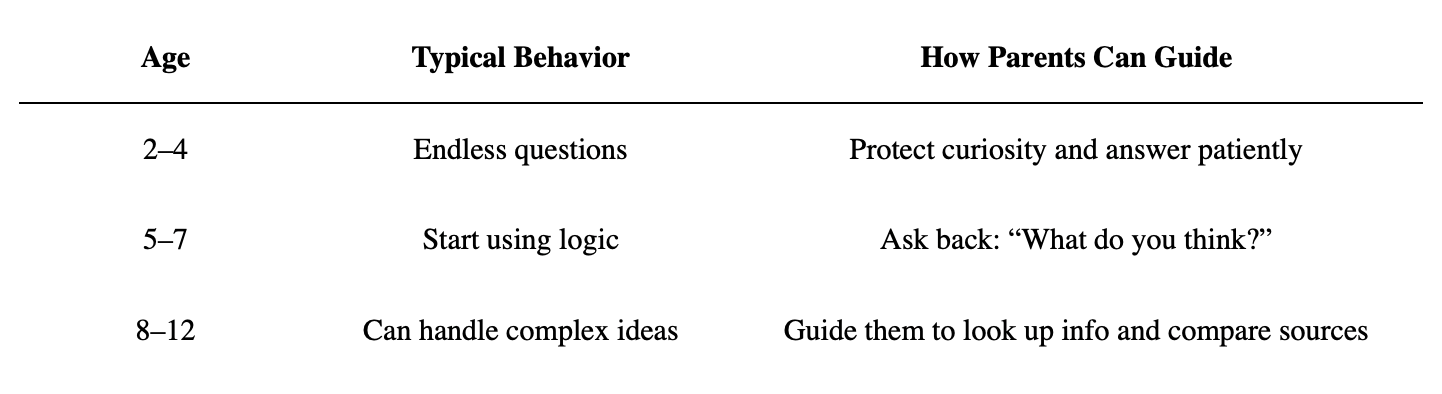
Kids naturally use questions to understand the world. Our job is to help that process keep going, not shut it down.
Want to Build Inquiry-Based Thinking? Start with Metacognition
Inquiry-based thinking is not about making kids ask more questions. It is about helping them understand how to ask, why to ask, and when to ask.
This connects to metacognition, which is simply “knowing what you’re thinking.” When kids can notice their own thought process, they can identify what they don’t understand. And that’s how good questions are born.
Research shows that even five and six year olds naturally form hypotheses, test ideas, and make conclusions through play. Kids already have the ability to think. They just need adults to help bring it to the surface.
5 Practical Tips You Can Use at Home
None of the following methods require special materials or teaching backgrounds. You only need time, patience, and a willingness to listen.
1. Create an environment where mistakes are safe
Kids will only ask when they feel secure.
Try saying:
“This is a great question. How did you think of it?”
“I didn’t understand this when I was younger either. Let’s look at it together.”
Comments like these show kids their questions matter.
2. Ask open ended questions to spark deeper thinking
Don’t jump to the answer. Toss the question back.
“What do you think might be the reason?”
“If it were you, what would you do?”
This gently deepens their thought process.
3. Add open discussions into daily life
Ask fun, imaginative questions during routine moments, like breakfast:
“If gravity in our house dropped to half, how do you think milk would pour?”
“If you were the principal, which rules would you change?”
There is no right answer. Kids relax and think more freely.
4. Help them reflect on their own thinking
This is where metacognition grows strongest.
You can ask:
“How did you come up with that idea?”
“What would you do next time something like this happens?”
The more they understand their thinking, the better their questions become.
5. Mix free exploration with structured challenges
Blocks, science toys, and board games work great.
You can start with a challenge:
“Can you build a bridge strong enough to hold ten books?”
Then give them time to build however they want. The mix of structure and freedom sparks both creativity and logic.
Curiosity Is a Child’s Most Natural Teacher
Inquiry based thinking does not require kids to become scientists or ask perfect questions. The real goal is helping them know:
“I can think. I can explore. I can find answers.”
This ability stays with them for life. In a world that changes fast, kids who ask questions will grow stronger than kids who only memorize answers. Kids are born curious. Our role is to protect that curiosity and help it grow, not let it fade.
Give a child a safe space to ask questions, and they will show you a version of themselves that is smarter, deeper, and more creative than you imagined.