
Same GPA, Different Results: How Selective College Admissions Really Works
Every admissions season, I hear a version of the same story.
Two students from the same school apply to similar colleges. They have almost identical GPAs, similar extracurriculars, and even the same intended major.
Then the decisions come out.
One gets into a highly selective university.
The other gets rejected or waitlisted.
Parents start comparing notes.
“Her grades were the same as my son’s.”
“They were both in robotics.”
“They even applied to the same schools.”
So what happened?
Did one student secretly have better scores?
Did the admissions office make a mistake?
Usually, the answer is much simpler, and much more interesting.
When admissions readers evaluate applications, they’re not just comparing numbers or activity lists. They’re trying to understand who a student is, what drives them, and how they might contribute to the community they’re building.
And that’s where small differences can make a big impact.
Let’s break down the biggest ones.
1. It’s Not the Activity List. It’s the Depth and Impact.
Two students might both list:
robotics club
volunteering
research
debate team
On paper, that looks almost identical. But admissions readers don’t just scan titles. They look for details and impact.
They’re asking questions like:
What did this student actually do?
Did they take initiative?
Did anything change because of their involvement?
Example Admissions Reader Scenario
Imagine an admissions officer reading two applications.
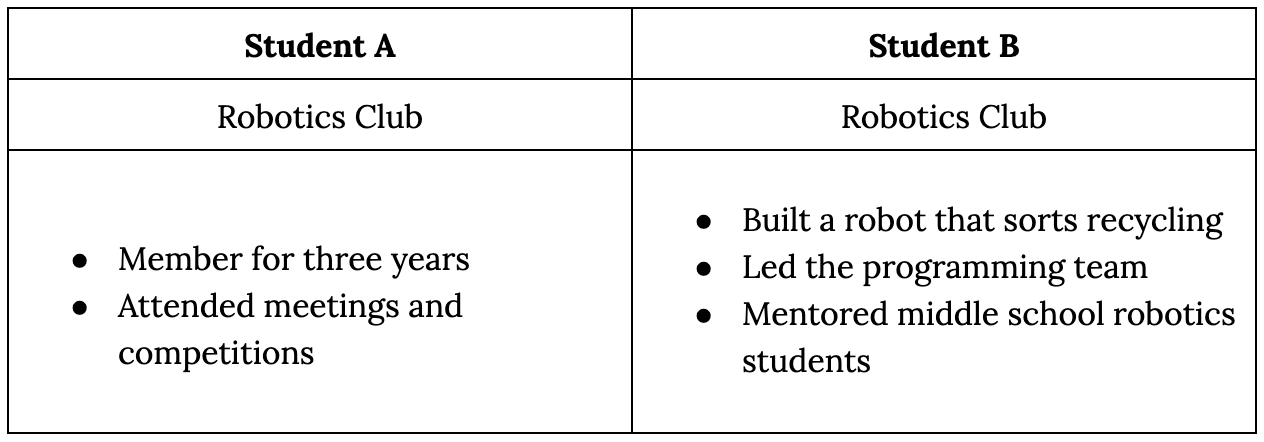
Both students list robotics.
But the level of engagement is very different. Selective colleges tend to notice depth and impact, not just participation.
2. Admissions Readers Look for Growth
Another thing admissions officers pay attention to is trajectory. They want to see how a student developed over time. Think of it like a storyline.
Academic growth might look like:
stronger grades in later years
taking harder classes related to interests
moving from curiosity to deeper exploration
Activity growth might look like:
joining a club → leading a project → mentoring others
volunteering → organizing a program → expanding it
When applications show progression, admissions readers get a clearer picture of the student’s potential. Believe it or not, the strongest applications show personal development, not just accomplishments.
Colleges want to admit students who are still growing, not students who have already peaked.
3. Does the Student’s Experience Match Their Intended Major?
Admissions officers also pay attention to something called alignment. In simple terms: Do the student’s interests match what they say they want to study?
For example:
A future engineer might have:
robotics projects
physics competitions
coding experience
A future public policy student might have:
debate
community advocacy
research on social issues
A future biology major might have:
lab research
science competitions
health-related volunteering
Students don’t need to have everything figured out at 16. but when experiences connect naturally to the intended major, it signals genuine curiosity. When they don’t, admissions readers sometimes pause.
For example:
applying for computer science
but all activities are music and sports
no evidence of technical exploration
Admissions officers might wonder: Why this major?
4. The Application Should Tell One Clear Story
Here’s something families often underestimate: Admissions readers don’t evaluate each part of the application separately. They read the entire application like a story. The strongest applications feel coherent.
For example:
activities reflect the student’s interests
essays explain why those interests matter
recommendations reinforce those qualities
the intended major makes sense
Everything points in the same direction.
Admissions officers read thousands of applications every year. When an application tells a clear story, it becomes much easier to remember.
5. Institutional Priorities: The Hidden Layer of Admissions
There’s another factor families rarely see. It’s called institutional priorities.
Colleges aren’t simply picking the “best” students. They’re building a class. That means admissions committees must balance many things, including:
different academic interests, especially in targeted disciplines
geographic, racial, gender, and socioeconomic diversity
financial stability, often tied to full-pay enrollment goals
first generation access, to serve social mobility and equity goals
special talents
legacy admissions and development connections
mission-driven initiatives, such as sustainability or civic engagement
Research from the National Association for College Admission Counseling shows that admissions decisions often consider institutional goals alongside individual achievements. This serves as a reminder that universities need students who fill specific roles that serve funding, mission, and reputational goals.
For example, in a given year a university might want more students interested in:
environmental science
public health
entrepreneurship
interdisciplinary research
competitive athletics
Another year, those priorities might shift.
These patterns appear year after year in strategic plans, Common Data Set data, mission and value statements, and even admissions case documents. Admissions officers rarely announce these priorities publicly, but they influence decisions behind the scenes.
If you see a school you’re targeting, ask yourself:
Where does my story naturally connect to these priorities?
What evidence do I have that fits what this school consistently seeks?
Can I highlight these connections, values, and/or qualities without forcing them?
6. Yes, Sometimes There Is a Little Luck
Here’s the honest truth. At highly selective colleges, there are far more qualified applicants than available spots.
That means many excellent students will still be denied.
Sometimes the difference between two strong applicants comes down to:
institutional priorities
department needs
class balance
timing
From the outside, that can look like luck. And in some ways, it is.
While students should never try to redesign their entire high school experience just to match what they think a specific college wants, it doesn’t hurt to position yourself if those alignments happen to be authentic.
Regardless, the better strategy is to focus on things that always matter:
genuine interests
meaningful impact
personal growth
a clear narrative about what excites you
If there’s one thing I wish more families understood about college admissions, it’s this: At highly selective universities, many applicants are academically strong.
The difference often comes down to subtle things that aren’t obvious when you’re simply comparing grades or activity lists:
the depth behind an activity
the growth behind a student’s journey
the alignment between interests, academic (and maybe institutional) goals
the clarity of the story the application tells
Those nuances are exactly what admissions readers look for. And they’re also the hardest things for students to see on their own.
Sometimes students have already done incredible things, but their application doesn’t fully show the meaning, impact, or growth behind those experiences. Other times, students are doing many activities but haven’t yet connected them into a coherent narrative about who they are becoming.
That’s where thoughtful guidance can make a real difference.
If you or your child would like help thinking through how to highlight those deeper parts of an application, feel free to reach out because helping students stand out is what gets us going at All-Out.
Our work focuses on helping students:
develop meaningful extracurricular paths
reflect on their experiences and growth
build authentic application narratives
present their strengths clearly and thoughtfully
Because in the end, the goal isn’t to manufacture an impressive résumé. It’s to help students tell a story that genuinely reflects who they are and what they care about.
And that’s exactly the kind of story admissions readers remember.